One tonne with every booking.
Every hotel booking made through IMPT, on imptghana.com or on any other IMPT site, funds one tonne of verified CO₂ offset. The offset is part of the price you already see, there is nothing extra to pay, and what was offset is reported for each trip.
How the offset works
Four steps, in this order. Nothing in them is optional, nothing is added at checkout, and none of it needs anything from you beyond the booking itself.
The tonne is not an average spread across a year and not a block bought in bulk at the end of one. It is funded booking by booking, and the credit is verified before it counts.
- 01You book a room at the live rateThe price on the page is the live rate for the dates you picked. Nothing is added to it for carbon.
- 02IMPT funds one tonne of verified CO₂ offsetEvery single booking funds one tonne, whichever IMPT site it was made from.
- 03The credit is retired against a registered projectThe tonne is matched to a registered climate project and retired there, so the same tonne cannot be counted twice.
- 04The offset is reported on your tripWhat was offset is attached to that journey rather than to a year-end total.
That is the whole mechanism. One booking, one live price, one tonne, reported back against the trip it belongs to.
Why carbon matters here
Ghana's landscapes store carbon in different ways: high forest in the south-west, mangroves along the coast, savannah in the north. Travel touches all of them. This guide explains what is at stake, where to see it, and how to move through the country with a lighter footprint, from shared transport and longer stays to refillable bottles and guides who live near the sites you visit.
Why carbon matters in Ghana
Ghana's climate is tropical, with a wet season and a dry season. Rains run roughly March to mid-November in the south and April to mid-October in the north, and the timing shifts from year to year. Carbon in Ghana is a land story as much as an energy one: forest that stores carbon, soil under cocoa and food crops, mangroves along the shore and savannah in the north. Each of these is affected by how land is used and by the weather.
Lake Volta, formed by the Akosombo Dam in 1965, is a major source of Ghana's hydroelectricity, so the national grid leans on rainfall. When the lake is low, other generation fills the gap. For a visitor the link is simple: the more electricity a trip uses and the more fuel it burns on the road, the larger its share of emissions. Long flights are often the biggest single item, which is one reason a longer stay beats a rushed one.
None of this asks visitors to carry guilt. It asks for attention. Small decisions, repeated across a trip, add up. Ghana's emissions per person are modest beside those of industrialised countries, and the people most exposed to heat, erratic rain and coastal erosion have done least to cause the problem. What a traveller can do is spend in ways that keep value local, choose transport that shares space with residents, and support the protected areas that hold carbon in trees, soil and mud.
Forest, cocoa and the reserves
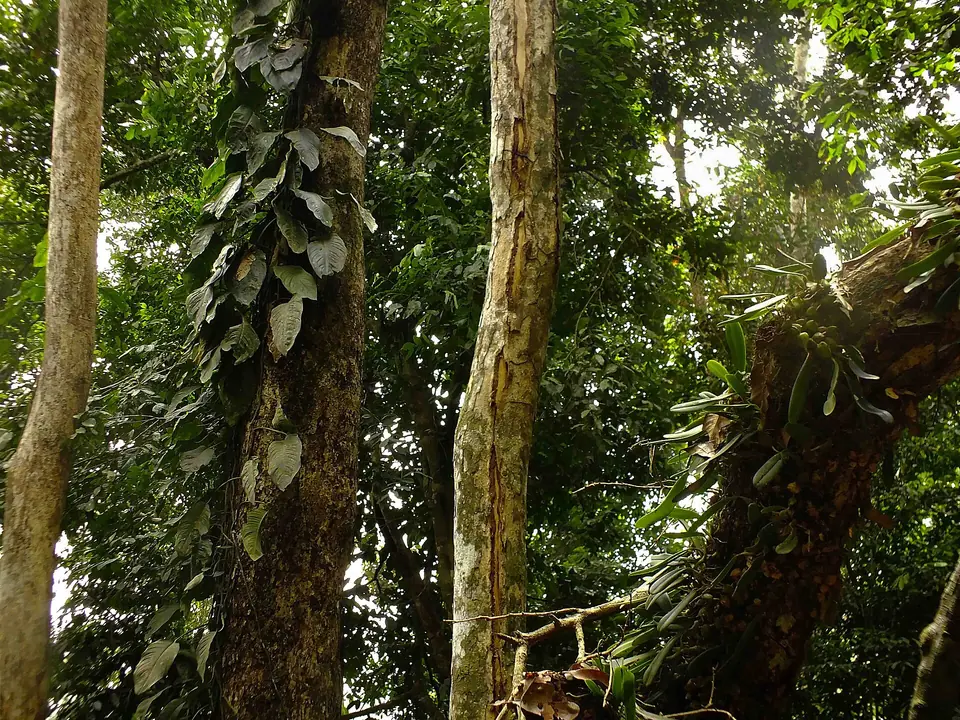
Ghana's south-west lies in the Upper Guinean forest zone, a belt of West African high forest. Much of the original cover has gone to farming, cocoa among the crops, along with logging and mining. What remains survives largely as forest reserves and national parks, managed by the Forestry Commission. The blocks are scattered rather than continuous, which makes each one matter for wildlife and for the carbon held in trees and soil. A forest cut into pieces loses species and holds less carbon over time.
Kakum National Park in the Central Region protects moist evergreen forest and has over 300 recorded bird species, according to the Ghana Tourism Authority. Its canopy walkway, seven suspension bridges forming a 333 m route up to 27 m above the forest floor, shows the structure of the forest: tall trees breaking the canopy, a middle storey, lianas and ferns. Walking it is also a lesson in how much carbon a mature forest holds above ground. Below ground, roots and soil hold a share that is harder to see and harder to replace.
The Atewa Range Forest Reserve in the Eastern Region is another of the remaining high forest blocks, and one often discussed in relation to water supply for nearby towns as well as wildlife. Reserves like these sit under pressure from farming, mining and timber. Visiting with a licensed guide, keeping to trails and paying the entry fee supports the case for keeping forest standing rather than cleared. Local groups and the Forestry Commission both have a say in what happens next, and visitors are part of that conversation.
Lagoons, mangroves and the coast
Along the coast, lagoons and mangroves do quiet work. Around the Keta Lagoon and the Volta estuary at Ada, mangrove roots slow the water, trap sediment and shelter young fish that later move out to nearshore waters. The same roots hold carbon in mud and in living wood. For communities that fish and farm nearby, these are working habitats rather than scenery, and their health shows in catches and in how the shoreline behaves. A healthy mangrove edge takes the sting out of storms.
Coastal erosion has long affected Keta, where sea defences were built to hold the shore. The town's position between lagoon and sea makes it a place to see how coastal change is lived with, not only modelled. Travelling there is a reminder that adaptation costs money and takes years, and that the emissions driving sea-level rise come mostly from far beyond Ghana's borders. The defences are engineering; the daily adjustments are local knowledge. Ask before photographing homes, boats and fishing gear.
Ada Foah, where the Volta meets the Atlantic, and the estuary at Azizanya are leisure spots as well as sensitive habitat. Boat trips, birdwatching and fishing depend on the same water. Ask guides how they read the seasons and the catch, keep fuel and litter out of the channels, and treat the mangrove edges as the nursery they are rather than a place to push through. A guide paid properly has reason to protect the next generation of fish.
Heat, harmattan and the north
The north has one rainy season, peaking around August and September, and is hotter and drier than the coast. Savannah vegetation, grass with scattered trees, covers much of the landscape. Mole National Park, 4,577 km² of Guinea savannah, is Ghana's first and largest protected area and is managed by the Wildlife Division of the Forestry Commission. Its elephants and other wildlife draw visitors north, and the park's guards and guides are part of the local economy. Check current conditions before booking, since rain and dust both change the tracks.
The harmattan, a dry dusty desert wind, blows roughly December to March and is strongest in the north. It coats surfaces in fine dust, dries the air and can affect flights and road visibility. For travellers it means a scarf, eye drops and a little patience. It also shows how weather in Ghana connects to conditions far away in the Sahara, and why the dry season is a season, not just a gap between rains. Pack a light long-sleeved layer for dusty afternoons and evenings.
Heat shapes daily life: early starts, shade at midday, markets that move with the sun. Visitors who plan walks and climbs for the morning, carry water and take the harmattan seriously have easier trips. The same habits cut energy use, since time spent outdoors in the breeze needs less air conditioning than an afternoon in a closed room. Choosing a fan over a cold room, and shade over sealed glass, is a small habit that travels well. Build the day around cool hours and the trip becomes calmer as well as lighter.
Travelling lighter in Ghana
The largest lever is the shape of the trip: fewer places, longer stays. A week split across two regions usually means less flying, less driving and more money going to one community. Distances in Ghana are real, and a schedule that crosses the country twice in a week burns fuel for little gain. A slower route through Accra, Cape Coast and Kumasi, or a northern loop from Tamale, is generally easier on the day. Two weeks in one half of the country often sees more than one week in all of it.
On the road, long-established intercity coach lines run air-conditioned services between major cities, and shared minibuses, known locally as trotros, cover the rest of the network. The UK Foreign, Commonwealth and Development Office notes that trotro drivers are not centrally licensed and advises against road travel outside towns after dark. Checking the current travel advice before a long road leg is sensible, and daylight journeys are easier anyway. A full coach carries many people for the fuel of one vehicle, which is the simple arithmetic of shared travel.
Domestic flights link Accra with Kumasi, Tamale and Takoradi, with lighter traffic through Sunyani and Wa and no scheduled flights at Ho in 2025; schedules change, so confirm before booking. Flying makes sense for a long hop such as Accra to Tamale, less so for a short one with a road alternative. Accommodation booked through IMPT includes one tonne of verified CO₂ offset in the price, reported for each trip. That offset sits alongside the choices above rather than replacing them.
What to see and support
Community-run sites put money where the conservation happens. Tafi Atome Monkey Sanctuary in the Volta Region protects Mona monkeys held sacred for about 200 years, with community protection beginning in 1996; guides there explain the forest edge as well as the monkeys. At Nzulezu, the stilt village over Lake Tadane near the Côte d'Ivoire border, local guides lead visitors along the boardwalk and talk about life on the water. Both places work with guides, and paying them is part of the visit.
Elsewhere, the point is to pay for protection already in place: entry fees at Kakum, Mole and Shai Hills, and guided walks in forest reserves. Around Cape Coast and Elmina, the castles form part of a UNESCO World Heritage site listed in 1979 and tell the history of the trans-Atlantic slave trade. Guides there are residents, and their work is part of the local economy. Booking locally keeps more of the value in the area. A calm visit with time for questions tells you more than a rushed circuit of many sites.
Food and drink choices count too. Ghanaian staples, cassava and plantain in the south, millet and sorghum in the north, with yam, maize and beans eaten nationwide, come largely from nearby farms. Carrying a refillable bottle and asking where safe drinking water is sold removes a steady trickle of plastic. Buying in markets, and from craftspeople at the sites, supports households that also steward the land and the water. Street food cooked to order is often the freshest option, and it keeps money in the neighbourhood.
- Stay longer: Two weeks in fewer places usually means less internal flying, less road fuel and more money reaching one community.
- Share the road: Intercity coaches and shared minibuses carry many people for the fuel of one vehicle, and daylight journeys are easier.
- Fly the long hops: Domestic flights suit a long leg such as Accra to Tamale; for shorter distances the coach is usually the lighter choice.
- Carry a bottle: A refillable bottle plus a plan for safe drinking water keeps a steady stream of small plastic bottles out of the trip.
- Pay local guides: Guides at community-run sites turn visitor income into a reason to keep forest, monkeys and mangroves in place.
- Book through IMPT: Every hotel booking made through IMPT funds one tonne of verified CO₂ offset, included in the price and reported for each trip.
The projects behind the credits
The credits are retired against registered climate projects: biogas and biomass on farms, forest restoration and REDD+, wind, solar, hydro and bio-based construction. The list below is read straight from the IMPT project register.
Descriptions come from the register itself and are published in English. Projects in India are shown first; the rest are in the app.


Buy or gift verified offsets
You do not have to book a room to fund a tonne. Both vouchers live in the IMPT app.
Worth knowing: the offset on a booking is funded by the booking. The vouchers are a separate thing you can buy or give away; a stay does not need one.
Carbon in Ghana: questions
How does a trip to Ghana affect the climate?
Flights to and from West Africa are usually the largest part of a visitor's footprint, followed by road travel and electricity use. Ghana's own emissions per person are modest beside industrialised countries, and the people most exposed to heat, erratic rain and coastal erosion have done least to cause the problem. A longer stay spreads the flight cost.
Do Ghana's forests store carbon?
Yes. The remaining high forest of the south-west, much of it in reserves and parks, holds carbon in trunks, roots and soil. Kakum National Park protects moist evergreen forest with over 300 recorded bird species, and the Atewa Range Forest Reserve is another block under pressure from farming, mining and timber. Keeping forest standing keeps that carbon in place.
What is the harmattan and when does it reach Ghana?
The harmattan is a dry, dusty desert wind that blows roughly December to March and is strongest in the north. It dries the air, coats surfaces in fine dust and can affect flights and road visibility. Pack a scarf, eye drops and a light long-sleeved layer, and check forecasts before a long journey north.
How can you travel between Ghanaian cities with a lower footprint?
Use the long-established intercity coach lines for the main corridors and shared minibuses for shorter legs; both carry many people for the fuel of one vehicle. The UK Foreign, Commonwealth and Development Office advises against road travel outside towns after dark, and notes that trotro drivers are not centrally licensed. Choose daylight journeys and check current advice.
Are mangroves on Ghana's coast important for carbon?
They are. Around the Keta Lagoon and the Volta estuary at Ada, mangrove roots slow the water, trap sediment, shelter young fish and hold carbon in mud and living wood. Coastal erosion has long affected Keta, where sea defences were built. Visiting with a guide, keeping fuel and litter out of the channels and paying for boat trips supports the people who depend on these waters.
Does booking a hotel through IMPT offset a trip?
Every hotel booking made through IMPT funds one tonne of verified CO₂ offset, included in the price and reported for each trip. It sits alongside the practical choices described here, such as longer stays and shared transport, rather than replacing them.
What can visitors do at Kakum National Park?
Kakum protects moist evergreen forest in the Central Region and has over 300 recorded bird species, according to the Ghana Tourism Authority. Its canopy walkway is made of seven suspension bridges forming a 333 m route up to 27 m above the forest floor. Guides lead groups across, and early mornings are cooler, so many visitors time the walkway for then.
How can you support conservation while travelling in Ghana?
Pay for guides and entry at community-run and protected sites, including Tafi Atome Monkey Sanctuary, Nzulezu, Kakum, Mole and Shai Hills. Buy food and crafts locally, carry a refillable bottle, and ask before photographing people, homes and boats. The Forestry Commission manages the reserves and, through its Wildlife Division, Mole National Park; residents do much of the work on the ground.
Why does land use matter as much as flights?
Flights are usually the biggest single item for a visitor, but in Ghana carbon is also a land question. Forest cleared for farming, logging or mining releases carbon and reduces what the land can store, while mangroves and savannah hold their own stocks. How land is used shapes both emissions and how communities cope with heat, dust and heavy rain.
Sources: IMPT project register (platform.impt.io); Ghana Forestry Commission, Ghana Environmental Protection Agency (EPA), Ghana Meteorological Agency. Editorial review: 13 November 2026.
Book a room, fund a tonne
Photo credits: Minham0910, CC BY-SA 3.0, via Wikimedia Commons.