Money and mobile money in Ghana
Ghana runs on the cedi, with cards in the cities, cash almost everywhere and mobile money in daily use. Here is how visitors can pay, withdraw and send money without friction.
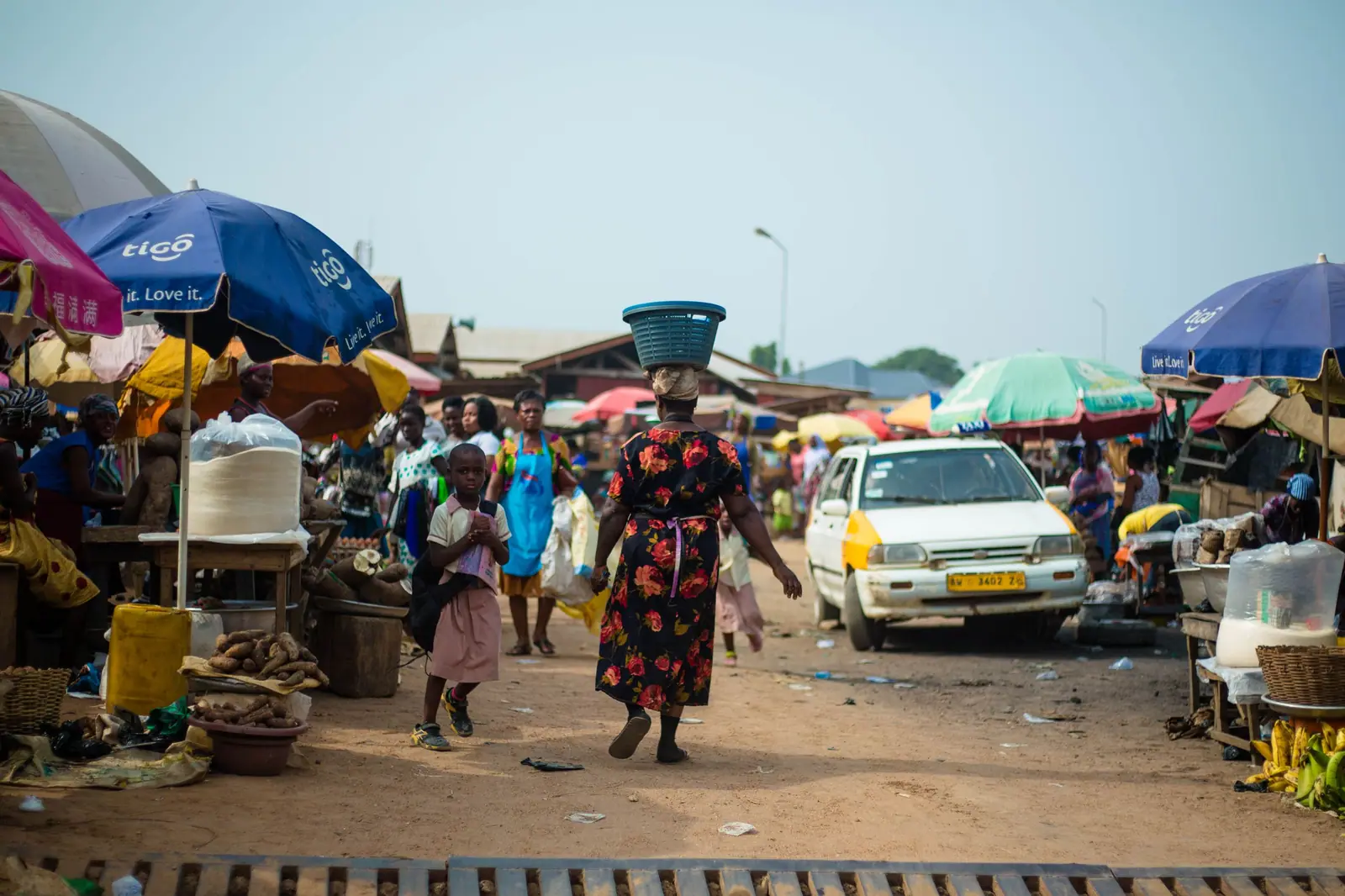
- Currency
- Ghana cedi (GHS), divided into pesewas
- ATMs
- Common in cities and larger towns
- Cards
- Accepted in cities, rarely in markets
- Mobile money
- Widely used; check visitor registration rules
The cedi, in plain terms
Ghana's currency is the Ghana cedi, written as GHS on receipts and bank screens. The cedi divides into pesewas, and notes and coins circulate side by side. Small transactions are often quoted in pesewas, so learn both. Cash remains the everyday instrument in markets, at roadside food stalls and on shared minibuses, so carry a mix of notes rather than one large one. Keep them flat and dry: traders in humid coastal towns are wary of torn or damp paper.
Learn the notes and coins on your first day so you are not fumbling at a till. Shops, supermarkets and filling stations price their goods, while market traders expect a conversation about the figure before anything is wrapped. Stalls rarely carry marked prices, so ask before you commit. Keep a few small notes aside for trotro fares, sachet water and tips, and one larger note for shops where change may be short.
Cards: where they work
Cards are accepted in Accra and other cities at larger hotels, supermarkets, some restaurants and the airports. Outside those settings, and in smaller towns, assume cash. Tell your bank the dates of your trip and set a travel notice on each card you bring. Carry a second card from a different network and store it apart from the first. If a terminal offers a choice, pay in cedis rather than your home currency, because the machine's own conversion is usually the poorer one.
Contactless payment is common where cards are taken, though not universal. Some terminals lose their connection mid-afternoon, so keep enough cash for the rest of the day. If a card is declined, ask the cashier to try once more or hand over another card; a refusal usually reflects a block on your own bank's side rather than a fault in the shop. Keep the printed slip until the amount appears on your statement, and check that statement at the end of the trip.
- Set a travel notice with your bank before you fly, and again if plans change.
- Carry two cards from different networks and keep them in separate places.
- Pay in cedis when a terminal offers a choice of currency.
- Keep a day's cash in reserve in case a terminal is offline.
ATMs and getting cash safely
ATMs are found in cities and larger towns, at bank branches, filling stations and the airports. They are thinner on the ground in the north and in small coastal villages, so draw cash before leaving a regional capital. Most machines dispense cedis and take international cards, but not every machine takes every network, so check the logos before you join a queue. Withdraw in daylight, at a machine set into a bank wall, and put the money away before you walk off.
Cover the keypad and ignore anyone who offers to help; cancel the transaction if the screen behaves oddly. If a machine swallows your card, report it at the branch inside and call your bank. Keep each receipt until you have checked your statement. Your bank and the machine's owner may both apply charges, so compare the total on the receipt with the amount your statement shows, and treat a failed withdrawal as pending rather than lost.
Tip: Take a modest amount each time rather than a large sum, and use a machine inside a bank or a busy filling station. Branch staff can tell you if it has been reliable.
Mobile money: the basics
Mobile money is a wallet held against a phone number. You put money in through an agent or a linked bank account, send it to another number, and the recipient collects cash from an agent or keeps it in the wallet. In Ghana the wallet does far more than transfers: it pays utility bills, buys phone credit, settles a market bill and covers a taxi. For many people it is the main way of holding and moving money, alongside cash.
Agents sit on street corners, outside markets and beside filling stations, and they usually display the networks they serve. Transactions are confirmed by a code sent to your phone, so a charged battery and a working SIM matter more than a card. Keep the confirmation message until the payment has cleared. If a transfer fails, the money normally returns to the wallet, but it can take a few days, so ask the agent for the reference.
- Sending money to a phone number, with a name check on the recipient.
- Paying utility bills and buying phone credit from the wallet.
- Withdrawing cash from an agent after a code arrives on your phone.
- Receiving money from family or customers, which stays in the wallet.
Mobile money as a visitor
Whether you can open a wallet depends on your nationality and on the identity documents you carry. Registration rules change, so ask at an agent or at a network's customer service point before you count on it. Some visitors register with a passport; others on short trips find cash and a card simpler. Either way, do not hand your phone or your PIN to anyone, including a helpful stranger who offers to speed things up.
If you cannot open a wallet, an agent can still send money to a Ghanaian number on your behalf, and a host or friend can pay and be repaid in cash. Ask for the transaction reference and keep it. Small traders may prefer a transfer from a Ghanaian wallet to a card, which is worth knowing when your cash is running low. Do not assume mobile money will work on a foreign SIM without checking first.
Tip: Save the customer service number for the network you use and carry a power bank. A flat phone is the most common reason a payment stalls.
Changing money and staying secure
Change foreign cash at a bank or a licensed bureau de change, both common in Accra and the larger cities. Bureaux usually post their rates and count the money in front of you, so ask for a receipt and check the arithmetic. Rates at the airport and in hotels tend to be less favourable than in town, so change a small amount on arrival and the rest later. Street changers offer quick deals, but the notes can be short.
Split money between a day wallet and a hidden reserve, and use a room safe where one is offered. Keep a photograph of your card numbers and passport details somewhere apart from the originals. Most payment trouble in Ghana is ordinary: a flat phone, a misplaced card, a machine that is offline. Report a lost card to your bank at once, and remember that a police report helps with any insurance claim.
Frequently asked questions
Do you need cash in Ghana, or can you rely on cards?
Take both. Cards work in Accra and other cities at larger hotels, supermarkets, some restaurants and the airports, but markets, roadside food stalls, trotros and smaller towns run on cash. Mobile money fills many of the gaps for Ghanaians, though visitors may not be able to open a wallet. Carry a mix of notes and a card, and keep a reserve apart from your day money.
Are ATMs easy to find in Ghana?
ATMs are common in Accra, Kumasi, Takoradi, Cape Coast and other cities, at bank branches, filling stations and the airports. They become scarcer in the north and in small coastal villages, so draw cash before leaving a regional capital. Not every machine accepts every card network, and machines sometimes run out of cash or go offline. Withdraw in daylight and keep the receipt.
Can visitors use mobile money in Ghana?
Sometimes. Opening a wallet depends on your nationality and the identity documents you carry, and registration rules change, so ask at an agent or a network's customer service point before you count on it. Some visitors register with a passport. On a short trip, cash and a card are often simpler, and an agent can still send money to a Ghanaian number on your behalf.
Which mobile money network should you use in Ghana?
Choose the network that the people paying you, or receiving from you, already use, since a transfer is simplest within one network. Agents usually display the networks they serve, and staff at a customer service point can explain what a visitor needs to register. Ask about charges before you send anything, and keep the confirmation message for each transaction until it clears.
What should you do if a card is declined in Ghana?
Ask the cashier to try once more, then hand over a second card from a different network. A decline usually comes from your own bank, which may have blocked the payment as unusual, so check your banking app or call the number on the back of the card. Keep enough cash for the rest of the day so a decline does not derail your plans.
How do you change money in Ghana?
Use a bank or a licensed bureau de change, both common in Accra and the larger cities. Bureaux usually post their rates and count the notes in front of you, so ask for a receipt. Rates at the airport and in hotels tend to be less favourable, so change a small amount on arrival and the rest in town. Avoid street changers.
Is tipping expected in Ghana?
Tipping is a matter of discretion rather than obligation, and nobody will demand it. A little extra is welcome in restaurants, at hotels and after a guided visit, and small notes make it easy. Ask whether a service charge has already been added before you add anything on top. For market traders, bargaining over the figure is normal and good humoured.
How safe is mobile money in Ghana?
Mobile money is widely used and well established, and transactions are confirmed by a code sent to your phone. The risks are ordinary: a lost phone, a shared PIN, a hurried transfer to the wrong number. Keep your PIN to yourself, check the recipient's name before confirming, and save the customer service number for the network you use. Keep confirmation messages until each payment clears.
Read next
IMPT Ghana editorial team · Reviewed 13 November 2026. Facts checked against the Ghana Tourism Authority (visitghana.com), the Ghana Immigration Service and other official sources listed in our editorial policy. Prices are never shown: live rates open in the IMPT app.
Find a stay in Ghana
Photo credits: Zeal Creative Studios / Pexels.