Cape Coast Castle visitor guide
Cape Coast Castle is the largest of Ghana's slave-trade forts, with dungeons at sea level, a Door of No Return and a museum above. Guided tours explain four centuries of trade and colonial rule.
- Region
- Central Region, Ghana
- British period
- 1664 until 1877
- Museum
- West African Historical Museum
- World Heritage
- Inscribed in 1979
What Cape Coast Castle is
Cape Coast Castle stands on the Atlantic shore in Cape Coast, the capital of the Central Region. It is one of the fortified trading posts that line the Ghanaian coast, and it forms part of the UNESCO World Heritage listing of forts and castles in the Volta, Greater Accra, Central and Western Regions, inscribed in 1979. The Ghana Tourism Authority describes it as the largest of the buildings tied to the transatlantic slave trade. Most visitors come for the dungeons, the museum and the seaward ramparts.
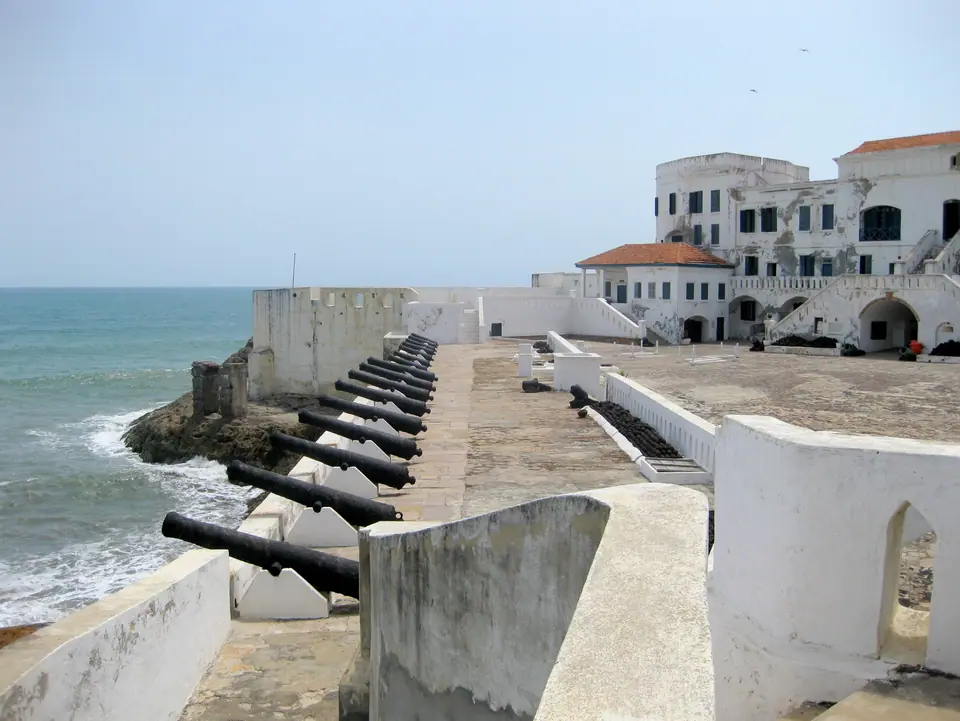
The castle is a working historic site rather than a ruin, with whitewashed walls, open courtyards and cannon on the upper platforms. Its buildings are layered: stores and dungeons at sea level, offices and quarters above. Visits are by guided tour, and an entry fee applies. Tours leave at intervals through the day and take in the dungeons, the Door of No Return and the museum, ending on the ramparts where the layout of the whole site becomes clear.
A short history
European powers built and fought over forts along this coast for centuries. The Portuguese raised Elmina Castle, 12.1 km west, in 1482. The British captured Cape Coast Castle in 1664 and made it their seat of government in the region until 1877, when the administration moved to Accra. In that time the castle served as a trading post, an administrative headquarters and a place where enslaved Africans were held before embarkation across the Atlantic.
The building you see today is the product of repeated rebuilding, repair and reuse, which is why the site reads as a record of four centuries rather than a single design. It is a protected monument and, with the other forts and castles, a World Heritage site. The castle now works as a museum and a memorial, visited by Ghanaians, school groups and travellers from the diaspora. The tour does not avoid the subject of the slave trade.
Dungeons and the Door of No Return
The route through the castle goes downwards first. Groups pass through low, dimly lit dungeons where enslaved Africans were confined before ships took them from the coast. The stone floors, narrow vents and heavy doors carry most of the weight of a visit, and guides explain how the trade worked, who ran the castle and who profited. The pace is slow, groups are usually small enough to hear, and there is time to stand and think.
The tour ends at the Door of No Return, the sea-facing opening through which captives were taken to waiting ships, and which many returning visitors treat as a place of remembrance. Above it, the upper floors hold the offices and quarters of the officials who ran the castle, along with a small chapel. The change between the two levels is the sharpest part of the visit, and the ramparts give long views along the coast.
- The dungeons at sea level, where captives were held before embarkation.
- The Door of No Return, the sea-facing doorway associated with the ships.
- The upper floors, with officials' quarters, offices and a small chapel.
- The ramparts, where cannon point out over the Atlantic.
Tip: Guides lead every tour and welcome questions. A tip at the end is customary but not required, and it is fine to ask for a slower pace.
Practical tips for the visit
There is no dress code, but the castle is a memorial as well as a museum, so loose, modest clothing suits the setting. The courtyards and ramparts are hot and exposed, while the dungeons are cool, low and dim. A hat, a bottle of water and shoes with grip on uneven stone make the visit easier. The visit often runs longer than expected, so leave room in the day.
Photography is generally allowed, including on the ramparts and in the courtyards. Ask your guide before photographing people, and check before using a flash in the museum or inside the dungeons, where rules can change. Voices carry in the enclosed spaces, so keep conversation low when another group is listening. The castle is also a place of remembrance for visitors with family connections to the trade, and quiet is appreciated. If you are unsure what is allowed, follow your guide's lead.
Getting there and when to go
Cape Coast sits on the coastal road west of Accra, and long-distance coaches and shared minibuses, known as trotros, cover the route. Takoradi Airport is 63.4 km away in a straight line, which makes the city a useful base for the western coast. The UK Foreign, Commonwealth and Development Office advises against road travel outside towns after dark, so plan to arrive in daylight. Check current departure times locally before setting out.
Southern Ghana has two rainy seasons, roughly April to June and September to November, and the harmattan haze blows from about December to March, milder on the coast than in the north. Cape Coast is busiest in September, when the Fetu Afahye festival is held. Allow at least half a day for the castle and museum, and a full day if you add Elmina and the coast road between them. The site is exposed, so a cloudy morning is often more comfortable than midday.
Tip: Mornings are cooler and quieter. If you are seeing both castles, start at Cape Coast Castle and continue west to Elmina, 12.1 km away.
Nearby sights and where to stay
Elmina Castle, 12.1 km west, was built by the Portuguese in 1482 and captured by the Dutch in 1637. It is the oldest European building in sub-Saharan Africa, with dungeons and its own Door of No Return. Inland from Cape Coast, Kakum National Park has a canopy walkway of suspension bridges above the forest. Cape Coast was the seat of British administration until 1877, which explains the scale of the old town. The harbour, the old quarters and the streets around the castle reward a walk.
Cape Coast town is the obvious base, with the castle, the museum and the main roads within reach. Elmina, 12.1 km west, is quieter and puts both castles within a short drive, which suits a two-day visit. Further west, Sekondi-Takoradi is the regional air gateway and a practical base for the coast towards Busua. Book ahead around Fetu Afahye in September and during Emancipation Month in July and August, when demand rises.
- Elmina Castle, 12.1 km west, with dungeons and a Door of No Return.
- Kakum National Park, inland from Cape Coast, with its canopy walkway.
- The older streets of Cape Coast town, around the castle and the harbour.
Frequently asked questions
What can you see on a tour of Cape Coast Castle?
Tours take in the dungeons at sea level, where captives were held, the Door of No Return facing the Atlantic, the upper floors used by officials, and the ramparts with their cannon and coastal views. The West African Historical Museum is inside Cape Coast Castle, and most tours end there or on the walls.
How long should you allow for Cape Coast Castle?
Half a day covers the guided tour, the museum and time on the ramparts without rushing. Add another hour or two if you want to sit with what you have seen or walk through the old town. Visitors combining Cape Coast Castle with Elmina Castle usually give the pair a full day.
When was Cape Coast Castle built?
Cape Coast Castle began as a fortified trading post on the Gulf of Guinea coast and changed hands between European powers before the British captured it in 1664. It then served as the British seat of government until 1877. The buildings you walk through today are the result of repeated rebuilding and repair over four centuries, so no single date fits the whole site.
Is Cape Coast Castle a UNESCO World Heritage site?
It is. Cape Coast Castle forms part of the World Heritage listing of forts and castles in the Volta, Greater Accra, Central and Western Regions, inscribed in 1979. The listing covers a group of coastal fortifications rather than a single building, and Elmina Castle, 12.1 km west, belongs to the same inscription.
How do you reach Cape Coast Castle from Accra?
Cape Coast lies on the coastal road west of Accra, and long-distance coaches and shared minibuses cover the route to the town, from where Cape Coast Castle is easy to reach. The UK Foreign, Commonwealth and Development Office advises against road travel outside towns after dark, so plan to arrive in daylight and check current departure times locally.
What should you wear to Cape Coast Castle?
There is no dress code, but Cape Coast Castle is a memorial as well as a museum, so loose, modest clothing suits the setting. The courtyards and ramparts are hot and exposed while the dungeons are cool and dim, so a hat and a bottle of water help. Shoes with grip are useful on worn stone stairs.
Can you take photographs at Cape Coast Castle?
Photography is generally allowed at Cape Coast Castle, including on the ramparts and in the courtyards, though rules can change and some interiors may be restricted. Ask your guide before photographing people, and check before using a flash in the museum or the dungeons. Voices carry inside the enclosed spaces, so keep conversation quiet when another group is nearby.
What else is there to see near Cape Coast Castle?
Elmina Castle is 12.1 km west, built by the Portuguese in 1482 and captured by the Dutch in 1637, with dungeons and a Door of No Return of its own. Inland, Kakum National Park has a canopy walkway above the forest. The old town around Cape Coast Castle is worth a walk, and the Fetu Afahye festival fills the streets in September.
Read next
IMPT Ghana editorial team · Reviewed 13 November 2026. Facts checked against the Ghana Tourism Authority (visitghana.com), the Ghana Immigration Service and other official sources listed in our editorial policy. Prices are never shown: live rates open in the IMPT app.
Find a stay in Cape Coast
Photo credits: Rjruiziii, CC BY-SA 3.0, via Wikimedia Commons.