Jamestown walking tour, Accra
Accra's old fishing quarter, where a colonial lighthouse, community boxing gyms and street art share the lanes with Ga families who have lived here for generations.
- Region
- Greater Accra
- Category
- Heritage walk
- Time needed
- About 3 hours
- From airport
- 9.2 km
What Jamestown is
Jamestown is the old quarter of Accra, built around a small headland where the sea meets the mouth of the Korle Lagoon. It grew as a Ga settlement and became the site of a British fort and trading post. The neighbourhood is still a working fishing community first and a visitor area second, which is the main reason a walk here feels different from a museum visit. Canoes are pulled up on the sand, nets are mended in the open and the sound of the surf runs under everything.
The name comes from the British, who took the fort from the Dutch in the seventeenth century and renamed the place after the Duke of York, later James II. Its Ga name is Ngleshie. For a long time it was a separate town from the European-built centre that grew up to the west, and that history of two settlements side by side still shapes how the city feels today. Walking the lanes gives you both layers at once: the fort and lighthouse above, the fishing beach below.
Tip: Start at the fort and work downward toward the beach, so the heat of the climb comes early and you finish near the water.
The lighthouse and the fort
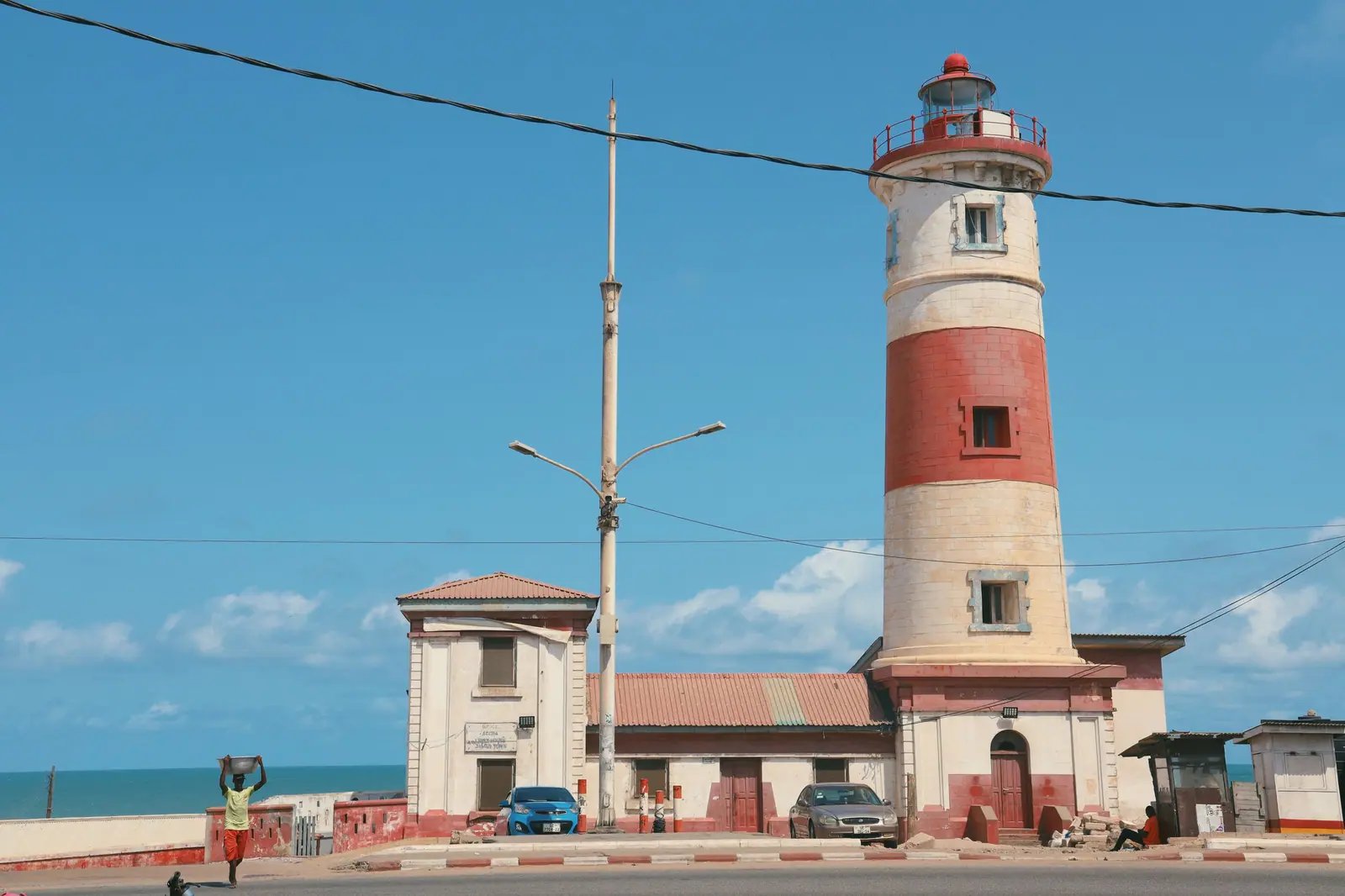
The red-and-white Jamestown Lighthouse is the landmark most people come to see. The present tower dates from the early 1930s and replaced an earlier light from 1871. It stands on high ground above the fishing beach, and the climb to its base gives a wide view over the canoes, the lagoon and the rooftops of the old town. The tower itself is about 28 m tall. Photography from the surrounding terrace is straightforward; access inside the tower depends on the day, so ask locally.
Beside it stands the old British fort, one of the chain of coastal defences that dot Ghana's shoreline. The forts and castles of Ghana are inscribed on the UNESCO World Heritage list as a single site, a group that includes the much larger castles at Cape Coast and Elmina. The Jamestown fort is modest by comparison, but its position explains why the settlement grew here: it commands the bay, the lagoon entrance and the approach along the shore.
- Ask before photographing the fishing crews at work on the beach.
- The climb to the lighthouse is short and steep; take it slowly in the heat.
- Views are best in clear morning light, before the coastal haze builds.
Boxing gyms and street art
Jamestown has a long association with boxing in Ghana, and small gyms in the quarter have trained fighters for decades. You may see open-air training sessions in the lanes or on the beach in the early morning and evening, with skipping ropes, bags and shadow work happening in the street. This is a working part of community life rather than a performance. Watch from a respectful distance, ask before taking photographs and do not walk through a session in progress.
The quarter is also known for its street art, which has grown up alongside the older buildings. Murals cover gable ends and yard walls, often drawing on local history, fishing life and Ga imagery. The Chale Wote Street Art Festival, held each August in Accra, has used Jamestown as a venue in some years and Osu in others, so check which location applies in the year you travel. Outside festival time the murals remain, and a walk will pass several of them. Look up as well as ahead.
Tip: Morning training and the fishing landings often overlap, so allow extra time around the beach if you want to watch either.
The Ga community and local customs
Jamestown is a Ga community, and the Ga are the indigenous people of the Accra plain. The annual Homowo festival, held in August and September, follows a ban on drumming that begins around May. Homowo means hooting at hunger and marks the harvest. Its rites are taken seriously and are not a visitor attraction, though the durbar and public elements can be watched if you are respectful and follow local guidance. Ask before entering courtyards or shrines, and do not photograph ceremonies without clear permission.
Ordinary courtesies go a long way here. Greet people before asking a question. Use your right hand when shaking hands or passing an object. Ask before photographing individuals, especially elders and anyone at work. Many people in the quarter are happy to talk about the area and will point you toward the fort, the lighthouse or a mural you might have missed. A short conversation often leads to a better visit than a checklist of sights, and it keeps the walk rooted in the place rather than in a route.
- Greet before asking directions or taking a photograph.
- Ask before entering a courtyard, shrine or private yard.
- Dress modestly; shoulders and knees covered is a safe default.
- Do not photograph ceremonies or rites without permission.
Getting there and getting around
Jamestown sits about 2.7 km from Independence Square in central Accra and about 9.2 km from Accra International Airport, the airport renamed in 2026 after years as Kotoka International Airport. The quarter is close enough to the centre to reach by shared minibus, known as a trotro, or by taxi. Trotros run along the main roads nearby, and the final stretch on foot is short. Agree the destination clearly, since several roads around the lagoon share similar names.
The walk itself covers a compact area of lanes, slopes and beach, and a route of about 3 hours allows for stops, conversation and photographs. Surfaces are uneven: sand, worn concrete, steps and open drains. Wear shoes you do not mind scuffing. Some sections around the fort involve a climb. If you are visiting independently, keep to the busier lanes and the main beach area, and consider a local guide for the narrower parts of the old town. The UK Foreign Office advises against road travel outside towns after dark, so plan to finish before evening.
- Wear closed shoes; the lanes are sandy, uneven and sometimes wet.
- Carry water; shade in the old town is limited.
- Finish before dark and travel between towns by day.
When to go and how to prepare
Accra is comparatively dry for the coast, but the city still has two rainy seasons, roughly April to June and September to November. The harmattan, a dry dusty wind, blows from about December to March and is strongest in the north of Ghana, though it can haze the coast too. Rain tends to come in short heavy bursts, so an early start usually works well. Mornings are cooler and the light is better for the beach and the lighthouse. Allow about three hours for the walk plus time for a drink afterwards.
Heat is the main practical concern. The quarter has little shade, and the combination of sun, salt and reflected light off the sea is stronger than it feels. A hat, water and a light long-sleeved layer are useful. For photography, ask before framing people and expect a mix of bright beach and deep shade under the fort walls. Guides are available locally and can be arranged in the area or through organisations in Accra. Fees for guiding, the lighthouse and the fort vary, so check current charges locally rather than relying on older information.
For the rest of the day, the Kwame Nkrumah Memorial Park is 1.6 km away and Makola Market is 1.8 km away, both easily combined with a morning in Jamestown. The memorial park holds the mausoleum of Nkrumah and his wife Fathia and reopened after redevelopment in 2023. Makola Market lines Kojo Thompson Road in central Accra. Pairing the quarter with one of these makes a full day without much travelling.
- Pair Jamestown with the Nkrumah Memorial Park or Makola Market.
- Check guiding and entry charges locally; they change.
- Carry a light rain layer in the wet seasons.
Nearby sights and where to stay
Beyond the two central sights, the wider city is within reach. The Cape Coast and Elmina castles lie much further west along the coast and need a separate day or an overnight stay. Shai Hills Resource Reserve is about 50 km from Accra and covers 52 km² of savanna. Aburi Botanical Gardens in the Eastern Region opened in 1890 and is about an hour's drive from the city. Each of these works as a half-day or full-day trip rather than a stop on the Jamestown walk.
For accommodation, most visitors base themselves in central Accra, around Osu, the Airport Residential Area or the streets near Independence Square, all within a short drive of Jamestown. Staying central keeps the walk easy to reach early in the morning and puts the museums and markets nearby. Booking platforms and the app list current options with live prices. Check the location against your other plans, since traffic in Accra can turn a short distance into a long journey at peak times.
Frequently asked questions
How long does the Jamestown walking tour take?
Allow about three hours for the walk itself, covering the fort, the lighthouse, the fishing beach and the lanes with the street art. Add time for conversation, photographs and a drink afterwards. Mornings are cooler and the light is better, so an early start makes the heat easier to manage.
What can you see on the Jamestown walking tour?
The red-and-white lighthouse from the early 1930s, the old British fort above the fishing beach, canoes and nets on the sand, small boxing gyms training in the open, and murals on yard walls. The quarter is a working Ga community, so much of what you see is everyday life rather than a set piece.
Is Jamestown in Accra worth visiting?
Yes, if you want a sense of how the city grew. It is the old quarter, built around a Ga settlement, a fort and a fishing beach, and it sits close to the centre. The combination of heritage, working harbour and street art is not repeated elsewhere in Accra, and the walk is short.
How do you get to Jamestown from central Accra?
Jamestown is about 2.7 km from Independence Square. Shared minibuses, known as trotros, run along nearby main roads, and taxis are easy to find. From Accra International Airport the distance is about 9.2 km. Agree the destination clearly, as several roads around the lagoon have similar names.
When is the best time to visit Jamestown?
Early morning is best: cooler, with better light on the beach and a good chance of seeing fishing landings and boxing training. Accra is comparatively dry, but the city has rainy seasons roughly April to June and September to November. The harmattan blows from about December to March and can haze the coast.
Is the Chale Wote festival held in Jamestown?
The Chale Wote Street Art Festival takes place in August, and its venue has moved between Jamestown and Osu in different years. Check which location applies for the year you travel before planning around it. The murals painted in the quarter remain visible outside festival time, so a walk still passes street art.
What should you wear and bring for the Jamestown walk?
Wear closed shoes you do not mind scuffing, since the lanes are sandy, uneven and sometimes wet. Cover shoulders and knees as a safe default. Bring water, a hat and a light rain layer in the wet seasons. Shade is limited in the old town, and the heat feels stronger near the beach.
Where should you stay near Jamestown?
Most visitors base themselves in central Accra, around Osu, the Airport Residential Area or the streets near Independence Square. All are a short drive from Jamestown and put the museums and markets within easy reach. Check the location against your other plans, as Accra traffic can stretch short distances at peak times.
Read next
IMPT Ghana editorial team · Reviewed 13 November 2026. Facts checked against the Ghana Tourism Authority (visitghana.com), the Ghana Immigration Service and other official sources listed in our editorial policy. Prices are never shown: live rates open in the IMPT app.
Find a stay in Accra
Photo credits: Ana Kenk / Pexels.