Kwame Nkrumah Memorial Park
The mausoleum and museum of Ghana's first president, set in landscaped grounds in downtown Accra, a short walk from Independence Square. Allow about two hours.
- Region
- Greater Accra, central Accra
- Nearest landmark
- Independence Square, 1.2 km
- Airport distance
- 7.6 km from ACC
- Time needed
- About two hours
The mausoleum and its story
Kwame Nkrumah led Ghana to independence on 6 March 1957, the first sub-Saharan African country to become independent. He was the country's first Prime Minister and later its President. The memorial park in downtown Accra holds his mausoleum and the tomb of his wife, Fathia, together with a museum. The site was redeveloped and reopened in 2023. It sits a short walk from Independence Square, close to the heart of the city's government and commercial district, and it is one of the stops that most visitors to Accra make.
The park is a working memorial as well as a visitor attraction, so expect quiet around the tombs and a more normal museum atmosphere in the galleries. National commemorations and school visits often take place here, and the mood shifts on public holidays. For visitors, the site is the clearest place in Accra to follow the story of independence and the man who led it, in the city where it happened. Allow time to sit in the grounds rather than pass straight through the buildings.
What to see in the park
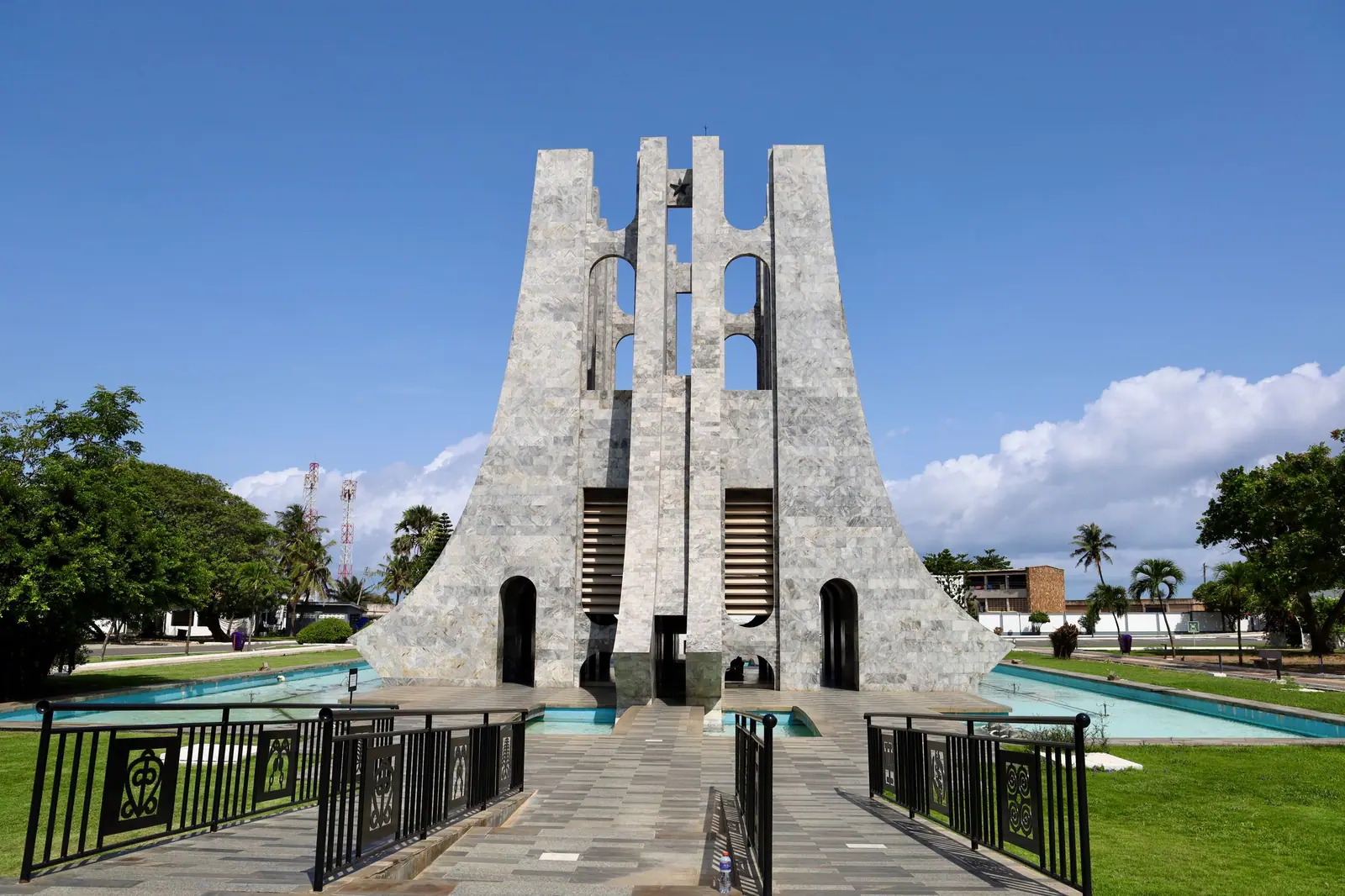
The mausoleum is the focal point: a large monument over the tombs of Nkrumah and Fathia, set on a raised platform in landscaped grounds. Visitors walk around it rather than through it, and the mood there is quiet. The scale is deliberate, and it reads as a national monument rather than a grave in a churchyard. Photographs of the exterior are the usual record of a visit, and there is shade around the edges of the grounds for a few minutes out of the sun.
The museum sets out Nkrumah's life and the independence period: photographs, documents and displays that follow the move from colonial rule to a republic in 1960. Labels are in English. Read the panels rather than walking past them, because the chronological sequence makes the politics much easier to follow. If you have limited time, go round the museum first and leave the grounds for the cooler part of the morning. Allow about an hour inside if you read most of it.
- The mausoleum of Kwame Nkrumah and Fathia, the focal point of the park.
- The museum galleries, which follow Nkrumah's political career and the independence years.
- The landscaped grounds, with shade and quieter corners away from the main paths.
- The wider memorial area, a short walk from Independence Square in central Accra.
Getting there
The park sits in downtown Accra, about 1.2 km from Independence Square and 7.6 km from Accra International Airport, which was called Kotoka International Airport until the government restored the original name in February 2026. From the Independence Square area the walk takes in some of the busiest streets in the city. Trotros and taxis cover the last stretch if the heat or the traffic makes walking less appealing. Ask the driver for the memorial park by name, because the entrance comes up quickly.
From the airport, the drive is short in distance and unpredictable in time. Central Accra traffic is heavy on weekday mornings and again from late afternoon, so build in slack before a flight or a fixed appointment. The UK Foreign and Commonwealth Office advises against road travel outside towns after dark, which is worth bearing in mind for evening plans. Check current conditions locally if you are travelling further afield.
Tip: Weekday mornings bring the worst of the traffic into central Accra. A late morning or early afternoon visit is easier to plan around.
When to go and how long
Accra is comparatively dry for a coastal West African city, but the south has two rainy seasons, roughly April to June and September to November. The harmattan, a dry and dusty wind from the desert, blows roughly December to March and can haze the sky and dry the throat. Mornings are cooler than afternoons at any time of year, and the grounds offer little cover if rain sets in. Public holidays, including Independence Day on 6 March, bring crowds and ceremonies.
Allow about two hours for the mausoleum, the museum and a walk round the grounds. Add an hour if you read the museum panels closely or sit for a while. Many visitors pair the park with Independence Square or a walk into Jamestown, which makes a half day in central Accra. Opening days and hours can change, so check with the Ghana Tourism Authority or the park before you travel. An entry fee applies.
Tip: Arrive in the morning if you can: the light is softer, the galleries are quieter and the walk between the tombs and the museum is cooler.
Nearby sights
Makola Market lines Kojo Thompson Road, about 0.6 km away, and is a large market in the heart of the city. It is a working market rather than a sight, so go with time to spare and keep bags close. Jamestown, about 1.6 km away, has the red-and-white lighthouse, a tower of about 28 m that dates from the early 1930s, and streets that reward a slow walk. Allow an hour or more if you plan to walk into the market itself.
Independence Square, about 1.2 km away, is the open ground on the coast where national ceremonies take place, and the walk between the square and the park passes through the government and commercial centre. Jamestown walking routes often take in the harbour area and the lighthouse. All of these are close enough to link on foot, though the heat makes a taxi between stops sensible in the middle of the day.
- Makola Market, about 0.6 km away, for food, cloth and household goods.
- Jamestown, about 1.6 km away, with its lighthouse and coastal streets.
- Independence Square, about 1.2 km away, the setting for national ceremonies.
- The central business district streets between the park and the coast.
Practical tips and where to stay
Dress for heat and humidity: light clothing, a hat and comfortable shoes for uneven ground. Modest dress is expected around the tombs, and covered shoulders and knees are a safe rule. Carry water, since shade in the grounds is limited. Ask staff before photographing inside the museum, where the rules may differ from the grounds. Guides may be available at the entrance, and it is worth agreeing the scope of a tour before you set off.
Most visitors stay in central Accra and walk or take short rides to the park. Osu, Cantonments and the Airport Residential Area have a wide range of places to stay and easy access to restaurants. Jamestown suits anyone who wants to be close to the coast and the old town. Staying near Accra International Airport helps for early flights, though it puts the park a short drive away rather than a walk.
Frequently asked questions
Where is Kwame Nkrumah Memorial Park?
It stands in downtown Accra, in the Greater Accra Region, about 1.2 km from Independence Square and 7.6 km from Accra International Airport. Makola Market and Jamestown are both within walking distance, so the park fits easily into a half day in the centre of the city.
Who is buried at Kwame Nkrumah Memorial Park?
The park holds the mausoleum of Kwame Nkrumah, Ghana's first Prime Minister and later its President, and the tomb of his wife, Fathia. Nkrumah led the country to independence on 6 March 1957. The museum beside the tombs sets out his political life and the early years of the republic, declared on 1 July 1960.
What can you see at Kwame Nkrumah Memorial Park?
The mausoleum is the centre of the site, a monument over the tombs in landscaped grounds. The museum covers Nkrumah's career, the independence campaign and the republic years, with photographs and documents on display. Allow time for the grounds as well as the galleries, since the two halves of a visit feel quite different.
How long does a visit to Kwame Nkrumah Memorial Park take?
About two hours covers the mausoleum, the museum and a walk round the grounds. Add an hour if you read the panels closely. If you pair the park with Independence Square, Makola Market or Jamestown, plan a half day, with a break out of the heat in the middle.
How do you reach Kwame Nkrumah Memorial Park from the airport?
Accra International Airport is about 7.6 km away. A taxi or a ride-hailing car is the simplest option if you have luggage. Traffic in central Accra is heavy on weekday mornings and from late afternoon, so allow extra time. Ask for the memorial park by name, because the entrance comes up quickly.
Can you take photographs at Kwame Nkrumah Memorial Park?
Photographs of the mausoleum and the grounds are normal, and most visitors take them. Rules inside the museum may be different, so ask staff before you photograph the displays, since flash and tripods are often restricted in galleries. Keep voices low near the tombs and ask before photographing other visitors close up.
What should you wear to Kwame Nkrumah Memorial Park?
Light clothing suits the heat, with a hat and shoes that cope with uneven ground. Covered shoulders and knees are a sensible choice at a memorial with tombs. Carry water, because shade in the grounds is limited. Rain is possible in the wetter months, roughly April to June and September to November, so a light waterproof helps.
When should you visit Kwame Nkrumah Memorial Park?
Mornings are cooler than afternoons at any time of year. The harmattan, a dry and dusty wind, blows roughly December to March and can haze the sky. The southern rainy seasons fall roughly in April to June and September to November. Independence Day, on 6 March, brings ceremonies and larger crowds.
Read next
IMPT Ghana editorial team · Reviewed 13 November 2026. Facts checked against the Ghana Tourism Authority (visitghana.com), the Ghana Immigration Service and other official sources listed in our editorial policy. Prices are never shown: live rates open in the IMPT app.
Find a stay in Accra
Photo credits: Ana Kenk / Pexels.