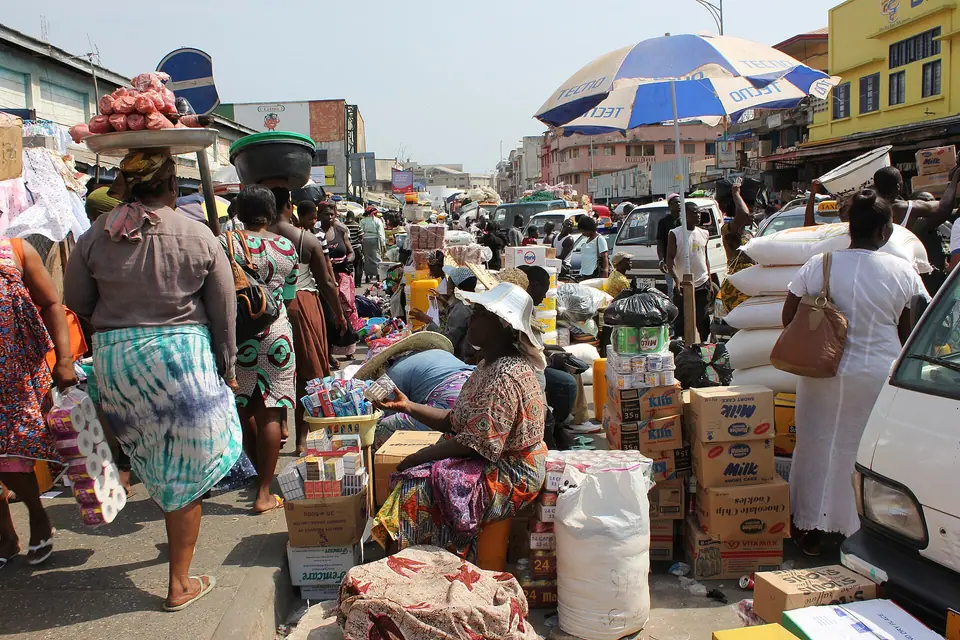
Makola Market in central Accra
Accra's largest market fills a grid of lanes off Kojo Thompson Road with cloth, beads, spices and household goods. Go early, go with a guide, and allow two to three hours.
- Category
- Markets and craft
- Location
- Central Accra, Kojo Thompson Road
- From the airport
- 7.5 km straight line
- Time to allow
- Two to three hours
What Makola Market is
Makola Market is the trading heart of central Accra and the largest market in the city. It lines Kojo Thompson Road and spills into the surrounding streets, a dense grid of stalls, tables, headpans and handcarts. Fabric, beads, spices, produce, cosmetics, kitchenware, school supplies and hardware are all sold here, usually in specialist clusters rather than in one open hall. It is a working market first and a visitor attraction second, which is exactly why it rewards a slow, curious walk.
The market sits close to the old core of the city, within walking distance of the Kwame Nkrumah Memorial Park and the coast at Jamestown. Because it serves both wholesale and retail buyers, the tempo shifts through the day: trading is brisk early, and the stalls thin by late afternoon. Walk the edges as well as the main lanes, since the side streets hold the quieter trades, among them bead stringing, tailoring and small metalwork.
Traders and trading history
Market trading has shaped Accra for far longer than the modern city grid has existed, and Makola grew into the central ground where goods from the coast, the forest and the northern savannah changed hands. The trade here has long been run largely by women, who hold stalls, organise credit among themselves and pass trading networks down through families. That continuity is part of what you see: the market is not a reconstruction of older commerce but the present form of it.
Goods arrive from across Ghana and from neighbours along the coast. Plantain, cassava, yam and maize come in from farming areas; kente and other cloth from weaving towns such as Bonwire and Adanwomase in Ashanti; beads, shea and spices from the north. The result is a market where a single lane can hold several regional economies at once. Ask where something was made and you will usually get a straight answer, and often a story about the town it came from.
What to see and buy
Start with cloth. The market holds printed cotton, wax print, lace, head-tie fabric and handwoven kente, and sellers will tell you which cloth suits which occasion. Beads come next: glass beads strung by hand, waist beads sold by the strand, and larger ceremonial pieces. Spices and dried goods are heaped in bowls, including pepper, ginger, grains of selim and dried fish. Beyond that, expect everything a household needs, from enamel bowls to school uniforms to phone accessories.
Bargaining is normal on most goods, though food sold by the bowl is usually fixed. Ask the price, then counter politely and keep it friendly; walking away is part of the exchange, not an insult. Buying something small from several stalls is a good way to see more of the market and to be remembered kindly by the people you pass. If you plan to photograph a trader or a stall, buy first or ask first, and accept a refusal without pressing.
- Wax print and lace sold by the piece, with tailors nearby who will sew to measure.
- Hand-strung glass beads and waist beads, sold by the strand from tables in the side lanes.
- Ground pepper, dried fish, grains of selim and other spices, weighed out from bowls.
- Household goods: enamel basins, cooking pots, brooms and plastic containers of every size.
- Kente and other handwoven cloth, usually identified by the weaving town it came from.
Getting to Makola Market
The market sits about 1.6 km from Independence Square in the city centre, and roughly 7.5 km in a straight line from Accra International Airport. In practice, road traffic decides the journey time, and central Accra can be slow at almost any hour. Shared minibuses, known as trotros, run to the surrounding terminals, and taxis will drop you at the edges of the market. Agree the drop-off point before you set out, since the lanes themselves are too narrow and too busy for cars.
Walk in from the main road rather than asking to be driven to a stall. The UK's Foreign, Commonwealth and Development Office notes that trotro drivers are not centrally licensed and advises against road travel outside towns after dark, so plan a daytime visit and a straightforward return. Keep bags in front of you and leave valuables behind. Anyone offering to guide you at the entrance is likely to expect payment, so agree the terms, the route and the finish before you start walking.
Tip: Ask a guide to begin in the quieter edge lanes and work inwards; the main road entrances are the busiest and the least rewarding.
When to go and how long
Mornings are best. Trading peaks early, the light is softer, and the heat has not yet built up. Weekdays are calmer than Saturdays, when much of the city seems to shop at once. Accra is comparatively dry for a coastal city, but the south has two rainy seasons, roughly April to June and September to November, and a downpour can turn the lanes slippery within minutes. The harmattan, a dry dusty wind, blows roughly December to March and leaves a fine film on everything.
Allow two to three hours for the market itself, more if you plan to buy cloth and have something sewn. Dress modestly and practically: shoulders and knees covered, closed shoes for wet or uneven ground, and a hat. Loose cotton is more comfortable than anything tight. Carry water, and expect to be pressed close in the narrow lanes. Photography is generally accepted in the open lanes, but always ask before photographing people, stalls or shrines, and put the camera away when you are not using it.
Tip: Two to three hours covers the main lanes; add an hour if you want cloth measured and a tailor consulted.
Nearby sights and where to stay
The Kwame Nkrumah Memorial Park is about 600 m away and holds the mausoleum of Nkrumah and his wife Fathia, plus a museum. It was redeveloped and reopened in 2023 and makes a calm contrast to the market. A guided walk around Jamestown, about 1.8 km off, takes in the old harbour quarter and the red-and-white Jamestown Lighthouse, a tower of about 28 m dating from the early 1930s. Both fit into a single day with the market.
For somewhere to stay, look at the central neighbourhoods within walking or short taxi distance: Osu and Labone to the east, Cantonments and Airport Residential further out, and the older quarters around Jamestown to the west. Staying central cuts travel time and lets you reach the market early. Check current travel advice for the city before booking, and confirm your route back with your host, since traffic and market-day congestion change the quickest way home.
- Kwame Nkrumah Memorial Park, about 600 m away, with the mausoleum and a museum.
- Jamestown walking tour, about 1.8 km off, through the old harbour quarter.
- Jamestown Lighthouse, a red-and-white tower of about 28 m from the early 1930s.
- The shoreline at Jamestown, for a view out along the Gulf of Guinea.
Frequently asked questions
Where is Makola Market?
Makola Market lines Kojo Thompson Road in central Accra, about 1.6 km from Independence Square and roughly 7.5 km in a straight line from Accra International Airport. Road traffic decides the real journey time. The lanes are narrow, so most visitors walk in from the main road rather than being driven to a stall.
What can you buy at Makola Market?
Cloth is the main draw: wax print, lace, head-tie fabric and handwoven kente. Beads are sold by the strand, spices and dried fish by the bowl, alongside plantain, cassava and yam. Household goods, cosmetics, school supplies and hardware fill the side lanes. Bargaining is normal on most goods, though food sold by the bowl is usually fixed.
How long do you need at Makola Market?
Allow two to three hours to walk the main lanes and the quieter side streets. Add an hour if you plan to buy cloth and consult a tailor, since choosing and measuring take time. Mornings are best, when trading peaks and the heat is lower. Weekdays are calmer than Saturdays.
When is the best time to visit Makola Market?
Early morning on a weekday, when the market is at its busiest and the day is still cool. Accra is comparatively dry, but the south has two rainy seasons, roughly April to June and September to November. The harmattan blows roughly December to March. Check the day's weather before setting out, since heavy rain makes the lanes slippery.
Do you need a guide at Makola Market?
A guide helps. The market is a dense grid with specialist clusters, and someone who knows it will take you to the cloth sellers, bead tables and spice stalls without wasted walking. Agree the route, the duration and the terms before you start. Anyone offering to guide you at the entrance will expect payment.
Is photography allowed at Makola Market?
In the open lanes, yes, but ask before photographing people, stalls or shrines, and accept a refusal without pressing. Buying something small first makes a request easier. Keep the camera out of sight when you are not using it, and avoid photographing anyone who has not agreed. Some traders prefer not to be photographed at all.
What should you wear to Makola Market?
Dress modestly and practically, with shoulders and knees covered and loose cotton rather than anything tight. Closed shoes cope better with wet, uneven ground. A hat and drinking water help with the heat, which builds through the morning. Carry a small bag in front of you and leave valuables behind where you are staying.
Which sights are near Makola Market?
The Kwame Nkrumah Memorial Park is about 600 m away, with the mausoleum of Nkrumah and his wife Fathia and a museum. A guided walk around Jamestown is about 1.8 km off and takes in the old harbour quarter and the red-and-white lighthouse. All three fit into one day with the market.
Read next
IMPT Ghana editorial team · Reviewed 13 November 2026. Facts checked against the Ghana Tourism Authority (visitghana.com), the Ghana Immigration Service and other official sources listed in our editorial policy. Prices are never shown: live rates open in the IMPT app.
Find a stay in Accra
Photo credits: Benggriff, CC BY-SA 3.0, via Wikimedia Commons.