Larabanga Mosque Visitor Guide
A whitewashed mud mosque on the edge of Mole National Park, thought to be the oldest in Ghana. Here is what to see, how to arrive and how to visit respectfully.
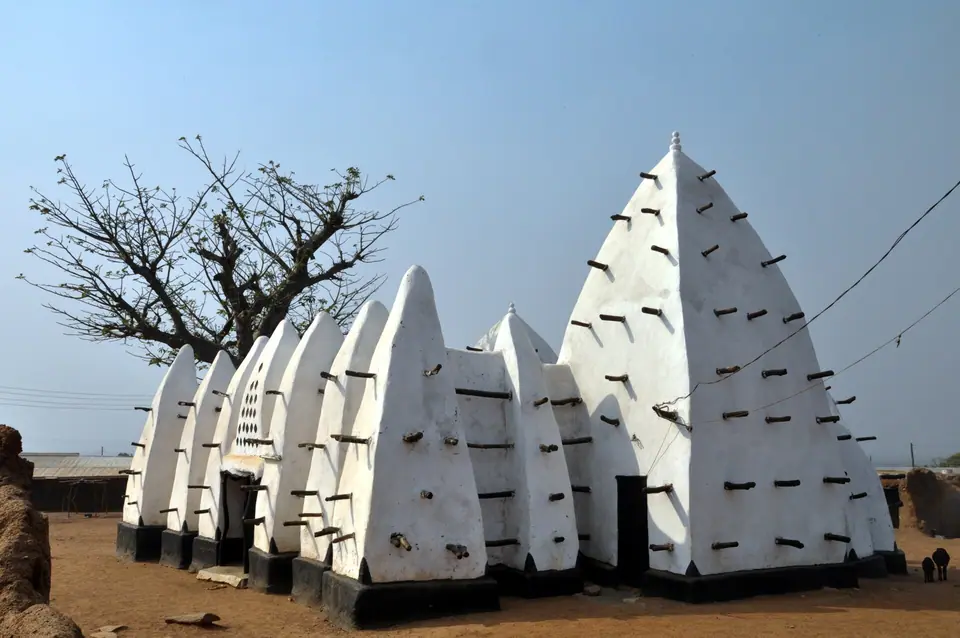
- Region
- Savannah Region, northern Ghana
- Category
- Heritage mosque
- Style
- Sudano-Sahelian mud and stick
- Nearest airport
- Tamale, about 116 km away
A mosque at Mole's gate
Larabanga Mosque stands in the village of Larabanga, in the Savannah Region of northern Ghana, about four and a half kilometres from the gate of Mole National Park. It is a Sudano-Sahelian building of mud and stick, finished in white, and it is the reason many visitors break the drive between Tamale and the park. The mosque is thought to be the oldest in Ghana and in West Africa. The date is disputed.
Tradition places its foundation in the early fifteenth century, and the building is often described as dating back to 1421, though that date is disputed. What you see today has been repaired and renewed many times, so the walls are younger than the site. The mosque is on the World Monuments Fund watch list, a recognition of how fragile mud architecture is in this climate. It remains a place of worship for the village rather than a monument.
Tip: Visits are usually arranged with a guide in the village. Ask on arrival and follow whatever the community asks of you.
The building and the village
The mosque is small, which surprises some visitors who know it from photographs. Its form is the classic Sudano-Sahelian one: a tapering earthen shell with buttresses and timber beams projecting from the walls. Those beams work as decoration and as permanent scaffolding, there to be used when the building is recoated. The white finish is what makes the outline read so clearly against dry ground. Look at the shape rather than the detail; the strength of the design is in the profile.
Allow time for the village as well as the building. Larabanga is a small village on the road to the park, and the walk from the main road to the mosque passes compounds and shade trees. Visits are usually made from the outside, with a look at the mihrab wall and the courtyard, and the interior is entered only with permission. Keep to the paths, ask before turning a camera on anyone, and remember that people live and pray here all year.
How to get to Larabanga
Most visits begin in Tamale, the capital of the Northern Region and the usual arrival point for the north. From Tamale the mosque is about 115 km in a straight line, with the road running through Damongo, the capital of the Savannah Region. The drive is longer than the straight-line figure, and slower in the rains. Road surfaces and conditions change with the season, so ask locally before setting out and allow for delays.
Tamale has an airport served by domestic flights from Accra; schedules change, so check before booking. From Mole National Park the mosque is a short drive of about four and a half kilometres, and many visitors combine the two. Shared minibuses, known as trotros, run between towns, but they will not take you to the mosque door. A vehicle with a driver is the simplest arrangement. The UK Foreign Office advises against road travel outside towns after dark.
Tip: Fix your return transport before you walk to the mosque. Traffic thins in the afternoon, and lifts back to Tamale or Mole are easier to arrange in the morning.
When to go and how long
The north has one rainy season, broadly April to mid-October and peaking around August and September. Outside those months the land dries out and the harmattan, a dusty desert wind, blows roughly from December to March. The harmattan is strongest in the north, hazing the horizon and cooling the early mornings. Dry-season months are the easier ones for combining the mosque with wildlife in Mole. Check conditions before travelling, since the rains can close tracks.
Set aside an hour or two at the mosque itself, plus the walk in from the road. Most people see it as part of a Mole stay, driving over in the morning and returning for the afternoon. If you are passing through between Tamale and Damongo, a stop of an hour is enough, but build in slack for the drive. The mosque is a working place of worship, so access can be paused during prayers. Check the day's arrangements when you arrive in the village.
- The harmattan blows roughly December to March, strongest in the north.
- The single rainy season runs roughly April to mid-October, peaking in August and September.
- Early morning and late afternoon are cooler and give softer light.
- Friday around midday is given over to prayers, so plan around them.
Nearby sights and where to stay
Mole National Park begins a few kilometres from the mosque and is the other reason to be here. It covers about 4,577 km² of Guinea savannah and is Ghana's first and largest protected area, managed by the Wildlife Division of the Forestry Commission. It holds the most viable elephant population in the country and has been on UNESCO's Tentative List since 2000. Guided drives and walks run from the park; check what is operating and book ahead in the dry season.
Larabanga village has simple places to stay, useful if you want the mosque at first light. Damongo, the Savannah regional capital, lies on the road back towards Tamale and has a wider choice of accommodation and food. Most visitors base themselves at or near Mole National Park, where lodges sit close to the gate, and drive over to Larabanga for an hour. Book ahead in the dry season, when the park is busiest, and confirm your booking directly.
Tip: Northern distances are longer than they look on a map. Base yourself at Damongo or near Mole and treat Larabanga Mosque as a half-day outing rather than a quick stop.
Practical tips for your visit
Dress for a place of worship rather than a beach. Shoulders and knees covered is the safe standard, and women may be asked to cover their hair, so a light scarf is worth carrying. Shoes come off at the entrance. The mosque is small and in daily use, so keep voices low, avoid walking across the prayer area, and wait if prayers are underway. Ask before you step inside; permission is usually given, but it is the community's to give.
The north is hot for most of the year, and the white walls throw light back at you. Carry water, wear a hat, and plan the visit for the cooler ends of the day. A local guide explains the building's history and the repairs, and knows where you may and may not walk. Photography is generally welcome outside; ask before photographing people and follow any request not to photograph the interior. Agree what a guide will show you before you set off.
- Cover shoulders and knees, and carry a scarf in case you are asked to cover your head.
- Take your shoes off at the entrance and keep your voice down inside.
- Ask before photographing people, and respect any request not to photograph the interior.
- Carry water and a hat; the north is hot even during the rains.
- Agree with your guide what the visit covers before you begin.
Frequently asked questions
Where is Larabanga Mosque?
Larabanga Mosque is in the village of Larabanga, in the Savannah Region of northern Ghana, close to the gate of Mole National Park. The park boundary is about four and a half kilometres away. Tamale, the capital of the Northern Region and the usual arrival point, is roughly 115 km away in a straight line.
How old is Larabanga Mosque?
It is thought to date back to 1421, which would make Larabanga Mosque the oldest mosque in Ghana and in West Africa, but the date is disputed. The building has been repaired and recoated many times, so the walls you see are younger than the site. It features on the World Monuments Fund watch list.
How do you reach Larabanga Mosque from Tamale?
Most visitors drive from Tamale, usually through Damongo, the Savannah regional capital. Larabanga Mosque is about 115 km from Tamale in a straight line, and the road is longer. Shared minibuses run between towns but will not stop at the door, so a hired vehicle with a driver is the simplest option. Ask locally about road conditions first.
How far is Larabanga Mosque from Mole National Park?
Larabanga Mosque is about four and a half kilometres from the gate of Mole National Park, a short drive on a road that can be rough after rain. Many visitors stay in or near the park and drive over in the morning. Allow an hour or two for the mosque and the village, plus the drive each way.
What should you wear at Larabanga Mosque?
Cover your shoulders and knees, and carry a light scarf in case you are asked to cover your hair. Remove your shoes at the entrance. Larabanga Mosque is a working place of worship, so choose quiet, plain clothing rather than beachwear, keep your voice low, and wait if prayers are in progress.
Can you take photographs at Larabanga Mosque?
Photographs of the exterior are generally welcome. Ask before photographing people, and follow any request not to photograph the interior. A guide can tell you where it is acceptable to stand. If someone asks you to stop, put the camera away; Larabanga Mosque belongs to the village and visitors are guests.
Should you visit Larabanga Mosque with a guide?
A local guide is worth arranging. A guide explains the building's history and the repairs it has had, and knows which paths and courtyards are open to visitors. Guides can usually be found in the village on arrival, though it helps to arrive in the morning. Agree what the visit covers before you begin.
When should you visit Larabanga Mosque?
The north has one rainy season, broadly April to mid-October, and a dusty harmattan from roughly December to March. Dry months are easier for combining Larabanga Mosque with wildlife in Mole. Whatever the season, visit in the morning or late afternoon, when the heat is milder and the light is softer.
Read next
IMPT Ghana editorial team · Reviewed 13 November 2026. Facts checked against the Ghana Tourism Authority (visitghana.com), the Ghana Immigration Service and other official sources listed in our editorial policy. Prices are never shown: live rates open in the IMPT app.
Find a stay in Ghana
Photo credits: Sathyan Velumani, CC BY-SA 3.0, via Wikimedia Commons.