Manhyia Palace Museum, Kumasi
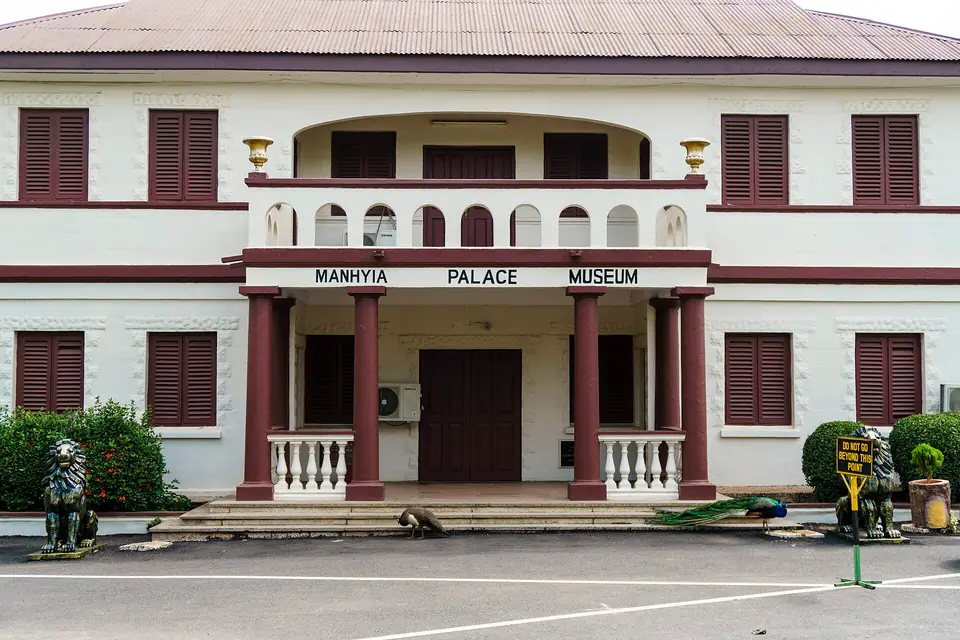
The former residence of the Asantehene in Kumasi, now a museum of Asante royal history, regalia and gold work, with the story of the Golden Stool at its centre.
- Type
- Royal palace museum
- City
- Kumasi, Ashanti Region
- Distance to centre
- About 1.1 km
- Nearest airport
- Kumasi (KMS), 3.1 km
The museum and its setting
Manhyia Palace Museum occupies the older Manhyia Palace in Kumasi, the capital of the Ashanti Region. Manhyia is the name of the Asante royal court and of the grounds around it, and the working palace stands close by. The museum is the former residence of the Asantehene, the king of the Asante people. It sits a little over a kilometre from Kejetia Market and about 3 km from Kumasi's airport.
Inside, the museum works as a history of the Asante kingdom told through its court. Displays cover the line of kings and the role of the Asantehene today, and the colonial period that shaped both. English is the official language of Ghana and the language of the labels, so a visit needs no translation. Most people spend their time in the main galleries and the courtyard, and a guide will point out the pieces that matter.
Palace history and the Golden Stool
The British arrested and exiled Nana Prempeh I in the 1890s. In 1900 the colonial governor's demand for the Golden Stool set off a war, led on the Asante side by Yaa Asantewaa. Nana Prempeh I returned from exile in the Seychelles in the 1920s, and the British built this palace for him. It served as the royal residence until the court moved to the new palace beside it, and the old building later opened as a museum.
The Golden Stool is the emblem of Asante unity rather than a seat for daily use. Asante tradition holds that it came down from the heavens to draw the kingdom together, and it is treated with great care by its guardians. The war of 1900 was fought over a colonial demand to hand it to the British. The stool was hidden, and it stayed with the kingdom. The museum sets out that history, and the effigy of Yaa Asantewaa stands among the past kings.
What to see inside
The main galleries hold Asante royal regalia and gold work, kept in cases and lit closely. The effigies are the pieces most visitors stop at: past kings, including Nana Prempeh I, and Yaa Asantewaa, queen mother of Ejisu, who led the Asante side in the war of 1900. Read the panels in order, since they set out the line of succession and explain which objects belonged to which reign.
The old palace itself is part of the exhibit. Rooms open onto shaded courtyards, and the scale of the building says something about how the court worked. Displays also touch on Akwasidae, the Asante festival held at Manhyia every six weeks on a Sunday, when the Asantehene receives visitors in state. That gives context to what you see indoors. A guide can tie the two together.
- The regalia and gold work, shown in cases through the main galleries.
- Effigies of past kings, including Nana Prempeh I, and of Yaa Asantewaa.
- Panels on the war of 1900 and the guardianship of the Golden Stool.
- The courtyards of the old palace, which link the display rooms.
Tip: Ask before taking photographs, since some displays are restricted, and dress with shoulders and knees covered. The palace is a royal and religious site as well as a museum.
Getting to Manhyia
The museum sits just outside the busiest part of central Kumasi, a little over a kilometre from Kejetia Market and its transport terminals, and about 3 km from Kumasi's airport. Most visitors arrive by taxi or by trotro, the shared minibuses that cover the city. Traffic is heavy through the working day, so allow slack. The FCDO advises against road travel outside towns after dark, and that advice is worth following for the return trip.
Entry is through the museum entrance, and an entry fee applies. Check opening days with the Ghana Tourism Authority or the palace before setting out, since the museum closes around palace ceremonies. Guides work at the entrance and inside, and a guided walk is the simplest way to follow the displays. The grounds are shared with the working palace, so keep to the visitor areas. Morning is cooler and quieter.
- Taxis and ride-hailing cars are easy to find around Kejetia and the city centre.
- Trotros run along the main roads past the palace grounds; ask which stop is closest.
- Walking from Kejetia is possible, though pavements are uneven and traffic is constant.
- From the airport, a taxi is the straightforward option and the road into town can be slow.
- On an Akwasidae Sunday, expect crowds and heavier traffic on the approach.
When to go and how long
Kumasi lies in the south of Ghana, with two rainy seasons, roughly April to June and September to November, and the dry harmattan wind from about December to March. The harmattan brings haze and dust rather than cold. Any month can be hot, and the middle of the day is the least comfortable time to be outside. Keep the visit indoors at midday if the heat is heavy, and carry water.
Allow about an hour and a half for the museum and its courtyards, more if you read every panel or wait for a guide. Opening days can change around palace ceremonies and public holidays, so check with the Ghana Tourism Authority or the palace before you travel. Akwasidae falls on a Sunday every six weeks, with no fixed month, so dates move each year and the year's dates are worth confirming.
Tip: Akwasidae Sundays draw crowds to Manhyia, and the museum may keep different hours. For quiet galleries, choose a weekday morning and check the day before.
Nearby sights and where to stay
Kejetia Market is about a kilometre away and is the obvious next stop. The Ghana Tourism Authority calls it the largest open-air market in West Africa, a claim worth taking as a description rather than a measurement. Bonwire, roughly 19 km from the museum, is the GTA's leading centre of kente weaving, and Adanwomase is the other royal kente village. Both make half-day trips from Kumasi.
Dress for a royal and religious site: shoulders and knees covered, and nothing that reads as beachwear. The heat is steady, so carry water and plan shade between stops. Photography is usually allowed in the main galleries but not everywhere, so ask a guide first. A guide also explains the order of the displays and the Asante protocol behind the objects, which is the difference between looking and understanding.
Places to stay cluster in central Kumasi around Adum and Kejetia, handy for the museum, the market and the transport terminals. The northern suburbs such as Nhyiaeso and Ahodwo are quieter and need a car or taxi for each trip. Ejisu, east of the city towards Bonwire, is a smaller base for the kente villages. Book ahead around Akwasidae and public holidays.
Frequently asked questions
What is the Manhyia Palace Museum?
It is the museum housed in the older Manhyia Palace in Kumasi, the former residence of the Asantehene. Displays cover Asante royal history, with regalia, gold work and effigies of past kings including Nana Prempeh I and Yaa Asantewaa. It is a heritage museum rather than a working palace.
Is the Manhyia Palace Museum the same building as the Asantehene's palace?
No. The museum occupies the older palace, built for Nana Prempeh I after his return from exile in the 1920s. The working palace stands close by at Manhyia and is not open to visitors in the same way. The museum is the building you tour.
Where is the Manhyia Palace Museum?
It stands at Manhyia in Kumasi, capital of the Ashanti Region, a little over a kilometre from Kejetia Market and about 3 km from Kumasi's airport. The grounds sit just outside the busiest part of the city centre.
How do you reach the Manhyia Palace Museum from Kejetia?
The distance is short, so a taxi or a trotro covers it quickly outside peak traffic, and walking is possible if you do not mind uneven pavements. Kejetia is the main transport hub, so most journeys in Kumasi start there. Traffic is heavy through the working day.
How long should you allow at the Manhyia Palace Museum?
About an hour and a half covers the main galleries and the courtyards at an easy pace. Add time if you read the panels in full, wait for a guide or visit on an Akwasidae Sunday, when the grounds are busy. Opening days can change around palace events, so check first.
Does the Manhyia Palace Museum explain the Golden Stool?
Yes. The Golden Stool is the emblem of Asante unity, held to have come down from the heavens, and the museum sets out its history, including the colonial demand for it in 1900 and the war that followed. The stool itself is treated as a sacred object with its own guardians.
Can you take photographs at the Manhyia Palace Museum?
In the main galleries, usually yes, but not everywhere, and some displays are restricted. Ask a guide or a member of staff before using a camera, and accept a refusal without argument. The building is a royal site, so dress with shoulders and knees covered whether or not you are photographing.
What else can you see near the Manhyia Palace Museum?
Kejetia Market is about a kilometre away, and Bonwire, the kente weaving centre, is roughly 19 km off. Adanwomase is the other royal kente village. The city's markets and the surrounding Ashanti towns fill out a day or two, and both villages make half-day trips.
Read next
IMPT Ghana editorial team · Reviewed 13 November 2026. Facts checked against the Ghana Tourism Authority (visitghana.com), the Ghana Immigration Service and other official sources listed in our editorial policy. Prices are never shown: live rates open in the IMPT app.
Find a stay in Kumasi
Photo credits: Dan Sloan, CC BY-SA 2.0, via Wikimedia Commons.