Bonwire: Kente Weaving Near Kumasi
Bonwire, a village in Ashanti close to Kumasi, is the place the tourism authority calls Ghana's leading centre of kente weaving. Half a day here shows the narrow loom at work and the cloth it produces.
- Region
- Ashanti, near Kumasi
- Time to allow
- Half a day
- From Kejetia
- 19.6 km, straight line
- From Kumasi airport
- 15.6 km, straight line
What Bonwire is
Bonwire is a village in the Ashanti Region, roughly 20 km from central Kumasi as the crow flies. The Ghana Tourism Authority calls it the leading centre of kente weaving in Ghana. Kente is a strip-woven cloth, made on a narrow loom in long bands and then sewn edge to edge into a wrapper. In Bonwire the craft is a working trade rather than a staged demonstration, and looms stand in workshops and courtyards along the lanes.
Kente has long been associated with Asante royalty, and Bonwire's weavers work within that tradition. Adanwomase, the other royal kente village, lies in the same part of Ashanti and makes a natural second stop. Patterns carry names, and a weaver will often explain what a design refers to before starting a new band. Cloth for sale in the village ranges from short table runners to full wrappers, so it is worth looking at several workshops before deciding.
At the looms
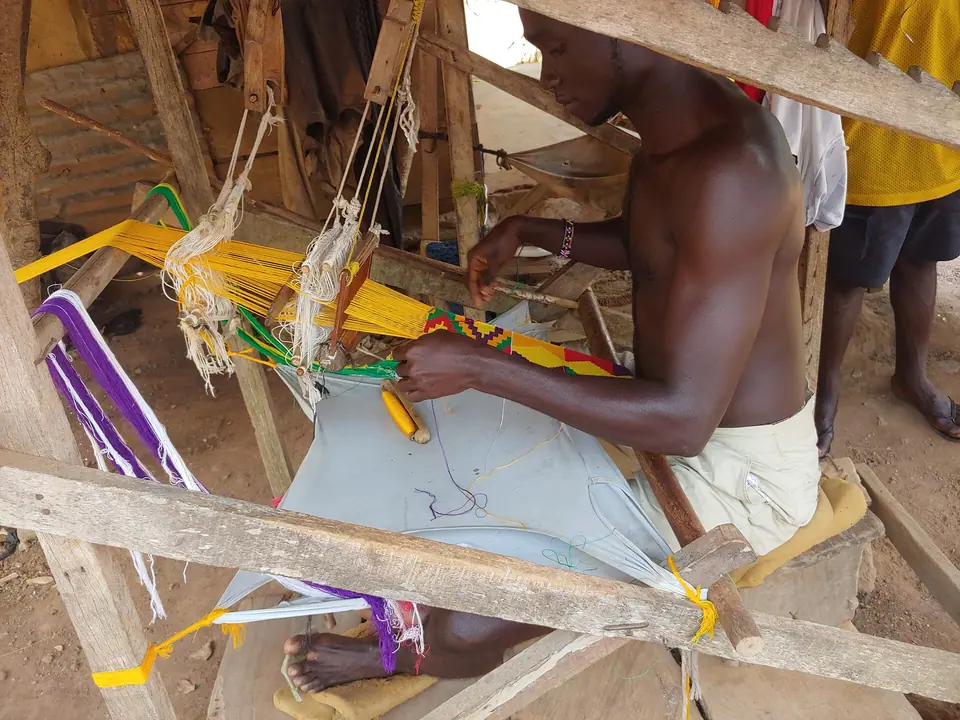
A kente loom is a simple wooden frame, low to the ground, with the warp threads stretched out in front of the weaver. The weaver sits at the far end and works two heddles and a set of treadles with hands and feet, passing a shuttle back and forth. Each band comes out narrow, and a full cloth is made by sewing several bands together. The work is slow, deliberate and often quiet.
Visitors are usually welcome to stand at the edge of a workshop and watch. Conversation is part of the visit: weavers explain the difference between patterns, show how a design is set up on the loom, and point out the bands that take longest. Apprentices often work beside experienced weavers, learning one pattern at a time. Expect a working atmosphere rather than a performance, and keep well clear of the threads.
- Ask before stepping inside a workshop; most weavers will pause and explain what they are making.
- Watch hands and feet together: the treadles raise the pattern while the shuttle lays the weft.
- Look at finished cloth as well as the loom, to see how separate bands become one wrapper.
- Keep bags and camera straps clear of the warp threads, which are held under tension.
Tip: Mornings are the steadiest time to watch work under way, before the heat builds and the light under a metal roof turns harsh.
Getting there from Kumasi
Bonwire sits about 20 km from Kejetia in central Kumasi and about 16 km from Prempeh I International Airport, both measured in a straight line. The road route is longer, so allow more time than those figures suggest, especially if you leave Kumasi in the morning peak. Shared minibuses run from the city to villages in the surrounding district, and a taxi for the day gives you the most flexibility. Agree your return time before you set off.
Once in Bonwire, the weaving workshops are close together and the village is small enough to walk. Ask where the looms are and someone will point you along the lane. If you come by taxi, agree a place and a time for collection before the driver leaves, because there is no formal rank aimed at visitors. A half day covers the village comfortably, leaving the afternoon free for Kumasi or for the road back.
When to go and how long
Southern Ghana has two rainy seasons, roughly April to June and September to November, and the harmattan, a dry dusty wind, blows from about December to March. None of this stops the looms, because weaving happens indoors under a roof. Rain makes the lanes muddy, and harmattan haze softens the light and dries the air. Mornings are cooler and the workshops are at their busiest, so aim to arrive early and check the forecast before a long drive.
Half a day is the right allowance for Bonwire. That covers the walk through the village, time at two or three workshops and a proper look at finished cloth. Weekdays are quieter than weekends, when families and groups tend to visit. If your trip coincides with Akwasidae, the Asante festival that falls on a Sunday every six weeks, Kumasi will be busy, so check the date before you plan. Public holidays also close some workshops.
Tip: Rainy-season showers usually pass quickly, but the lanes at Bonwire hold water. Sturdy shoes and a light rain jacket make a half day more comfortable.
Nearby sights
Kumasi is close enough to combine with Bonwire in one day. Manhyia Palace Museum, 18.6 km away, displays Asante royal regalia and gold work, with effigies of past kings including Prempeh I and of Yaa Asantewaa. Kejetia Market, 19.6 km away, sits at the centre of commercial Kumasi and is described by the tourism authority as the largest open-air market in West Africa, a claim worth treating as a claim. Set aside time for both if you are making a day of it.
Adanwomase, the other royal kente village in Ashanti, is the obvious companion stop and lets you compare how two communities work. Allow time in Kumasi itself: the centre around Kejetia is dense and slow to cross, and a guide helps if you want to see several places in one day. Distances here are straight lines, so the drive between stops takes longer than the numbers suggest. Lake Bosomtwe, the crater lake, needs a separate trip.
- Manhyia Palace Museum, 18.6 km away, holds Asante royal regalia, gold work and effigies of past kings.
- Kejetia Market, 19.6 km away, is the busy heart of commercial Kumasi and best visited with a guide.
- Adanwomase, the other royal kente village, makes a natural second weaving stop on the same day.
- Kumasi's own sights fill an afternoon, so settle the order of your stops before leaving Bonwire.
Practical tips and where to stay
Dress for heat and for a working village. Loose cotton clothing, a hat and a water bottle are sensible, and covered shoulders and knees fit the setting, particularly if you visit a mosque or enter a family compound. Ask before taking shoes off or walking into a courtyard. The ground is dusty in the dry season and muddy after rain, so closed shoes serve better than sandals. Midday heat is strong, so plan the walk for the morning or late afternoon.
Ask before photographing a weaver at work, and accept a no without pressing. Some people prefer not to be photographed, and a weaver may ask for a small payment for a posed picture; agree before you raise the camera. A guide is not essential in Bonwire, but a guide from Kumasi can explain pattern names and translate Twi. Arrange one through the tourism authority or where you are staying, and confirm the arrangement the day before.
Kumasi is the practical base for Bonwire, with the widest range of places to stay and the easiest transport. Staying in the city also puts Manhyia Palace Museum and Kejetia Market within a short drive, so a half day at the looms fits into a wider Ashanti itinerary. Smaller towns nearby have far less choice, and you would still need transport to reach the village. Book ahead if you travel around a festival or public holiday.
Frequently asked questions
Where is Bonwire, and how far is it from Kumasi?
Bonwire is a village in the Ashanti Region of Ghana. Straight-line distances put it 19.6 km from Kejetia in central Kumasi and 15.6 km from Prempeh I International Airport. The road route is longer than those figures, so plan for more time than the numbers suggest and check the current road conditions locally before setting out.
How do you get to Bonwire from Kumasi?
Shared minibuses run from Kumasi to the villages around it, and a taxi for the day is the most flexible option. Distances are short in straight-line terms, but the road route takes longer. Agree your collection point and return time with the driver in advance, since Bonwire has no formal visitor rank.
What happens during a visit to Bonwire's weaving workshops?
You will see narrow wooden looms set up in workshops and courtyards, with weavers working heddles, treadles and a shuttle to make long bands of cloth. Most visits involve watching, asking questions and looking at finished wrappers. Apprentices often work alongside experienced weavers, and the atmosphere is a working one rather than a show.
Do you need a guide at Bonwire?
No. The village is small, the workshops are easy to find on foot, and weavers are used to explaining their work. A guide is useful if you want pattern names translated or want to combine Bonwire with other Ashanti sites in one day. Guides can be arranged through the tourism authority or where you are staying.
When should you visit Bonwire?
The looms run all year, since weaving happens under a roof. Mornings are cooler and busier. Southern Ghana's rains come roughly April to June and September to November, and the harmattan blows from about December to March. Weekdays are quieter than weekends. Check public holiday dates, since some workshops close.
Can you buy kente cloth in Bonwire?
Yes. Workshops sell what they weave, from short table runners to full wrappers, and you can often watch a piece being made before buying it. Quality and pattern vary between workshops, so look at several before deciding. Ask how a cloth was woven and what the pattern is called, because weavers are usually glad to explain.
Is photography allowed in Bonwire?
Ask first, every time. Some weavers are happy to be photographed at the loom, others prefer not to be, and a posed picture may involve a small payment that should be agreed before you raise the camera. Photographs of finished cloth for sale are usually fine. Keep straps clear of the warp threads.
What should you wear and take to Bonwire?
Loose cotton clothing, a hat and drinking water suit the heat, and covered shoulders and knees fit a working village and any mosque you visit. Closed shoes cope better with dust and mud than sandals. Bring a light rain jacket in the wet season and small notes for water along the way.
Read next
IMPT Ghana editorial team · Reviewed 13 November 2026. Facts checked against the Ghana Tourism Authority (visitghana.com), the Ghana Immigration Service and other official sources listed in our editorial policy. Prices are never shown: live rates open in the IMPT app.
Find a stay in Ejisu
Photo credits: Sadads, CC BY-SA 4.0, via Wikimedia Commons.